1 Beijing Academy of Artificial Intelligence2 Institute of Information Engineering, CAS3 Beijing University of Technology
3.3KEngineering drawings
21KQuestion–answer pairs
10Fine-grained tasks
84.85MechVL-RL total score
Paper-reported dataset scale and evaluation results. See
resources for public release sizes.
01 / THE CHALLENGE
Every line carries meaning.
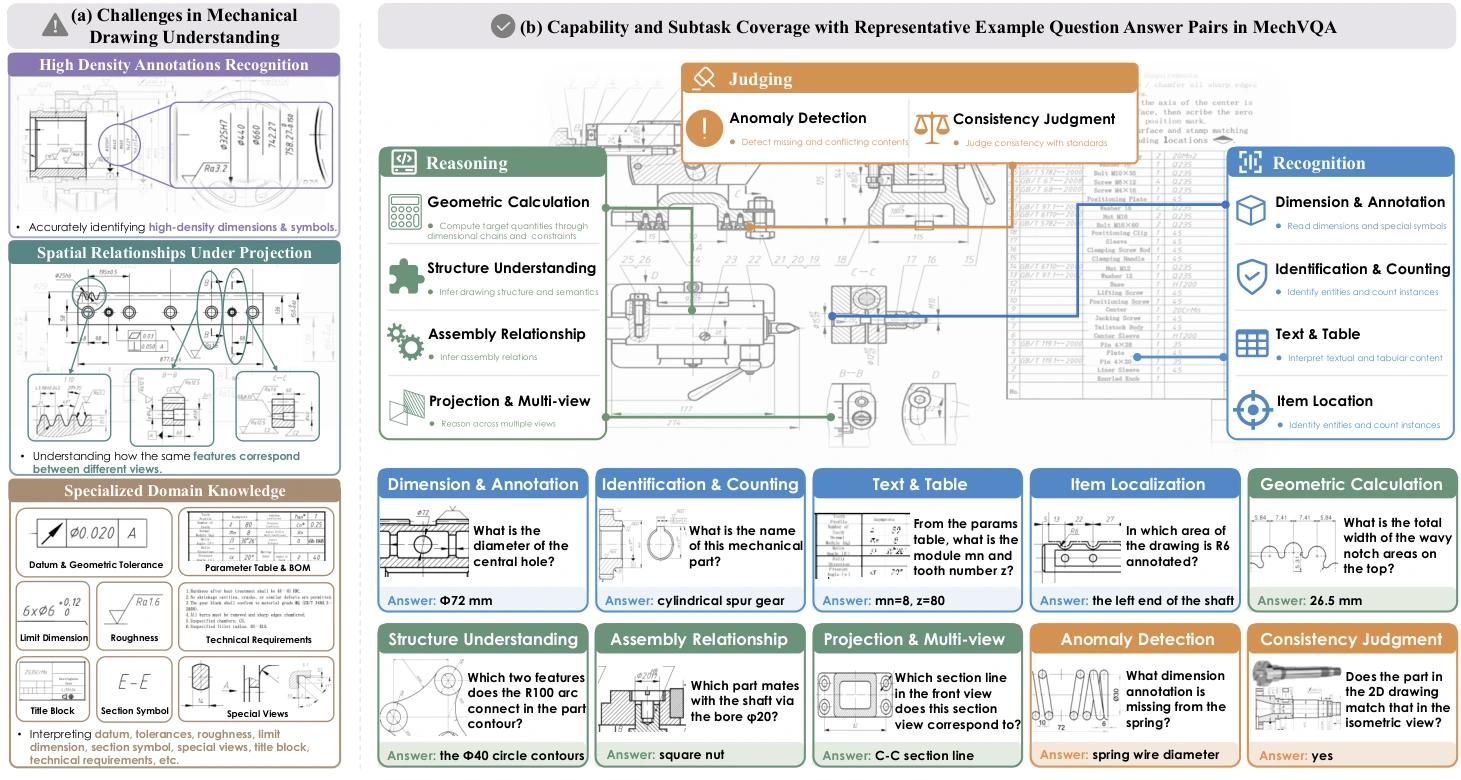
Mechanical drawings combine geometry, dimensions, tolerances, and
conventions in a single, information-dense image.
MechVQA tests whether multimodal models can understand that
language. It spans real part and assembly drawings, with questions
that move from visual recognition to spatial reasoning and
standards-aware judgment. MechVL builds on this benchmark with
supervised fine-tuning and two-stage self-play reinforcement
learning.
Benchmark overview and representative tasks.
Figure 1, MechVQA paper. Select the figure to enlarge.
02 / THE BENCHMARK
Read it. Reason about it. Check it.
Three capabilities. Ten tasks. Grounded in real engineering
drawings.
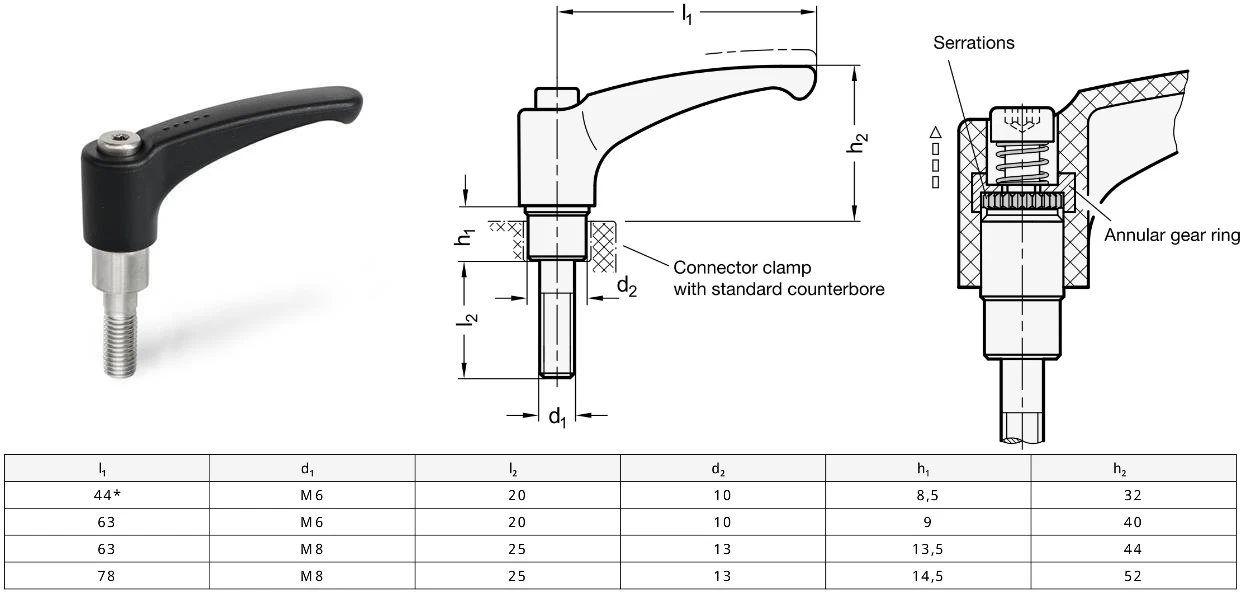
From the right-side sectional view, deduce the function of the
serrations and spring, and explain how they achieve the locking
function of the handle.
Show reference answer
The serrations provide a mechanical interlocking self-locking
surface, the spring provides axial preload to maintain
engagement, and compressing the spring disengages the teeth to
achieve unlocking.
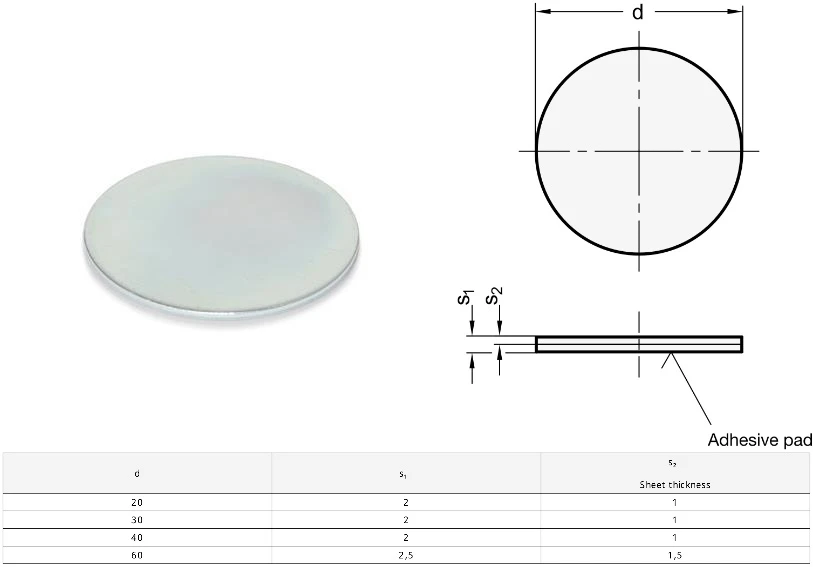
Based on the table data, calculate the difference between s1 and
s2 for d=20 and d=60, and determine whether the adhesive pad
thickness varies with diameter.
Show reference answer
According to the table data in the mechanical drawing: - When
d=20, s1=2, s2=1, difference s1‑s2 = 1; - When d=60, s1=2.5,
s2=1.5, difference s1‑s2 = 1. The difference for other
diameters in the table (e.g., d=30, d=40) is also 1. Since the
adhesive pad thickness equals the difference between s1 and
s2, and this difference is 1 for all diameters, the adhesive
pad thickness does not vary with diameter and remains
constant.
MechVL-4B-RL achieves the highest total score among the models
evaluated in the paper.
+7.57points
over Gemini-3-Pro-Preview, the strongest closed-source
baseline in this evaluation.
Results from
Table 2, arXiv v1
(May 2026). Accuracy on the paper’s test split; higher is better.
MechVL receives domain-specific post-training; general-purpose
baselines do not. This is a paper snapshot, not a live
leaderboard.
Selected models · MechVQA total score (%)
Model
Total ↑
MechVL-4B-RLOurs · SFT + self-play RL
84.85
GLM-4.6VOpen-source baseline
78.91
Gemini-3-Pro-PreviewClosed-source baseline
77.28
MechVL-4B-SFTOurs · supervised fine-tuning
76.36
GPT-5Closed-source baseline
75.44
Qwen3-VL-4B-InstructBase model
60.23
Total is the question-level aggregate, not an unweighted mean of
the ten subtask scores.
Evaluation protocol ↗
04 / MEET MECHVL
From a general model to an engineering specialist.
Qwen3-VL-4B-Instruct, adapted through supervised learning and
targeted self-play.
STAGE 01
Supervised fine-tuning
Learn drawing-grounded answers from MechVQA. Train the language
model while freezing the vision encoder and projector.
76.36 total score
STAGE 02
Full-data DAPO
Optimize on the full training split with rewards for answer
accuracy, response format, and explanation quality.
81.95 total score
STAGE 03
Targeted self-play
Resample underperforming subtasks and continue reinforcement
learning with the same objective and reward design.
The public releases and the paper’s full dataset have different
scopes. Additional internal training data are not included. See the
repository release status
for details.
06 / CITATION
Using this work?
Please cite MechVQA if you use the benchmark, MechVL models, or
released training and evaluation assets.
@misc{kou2026mechvqabenchmarkingenhancingmultimodal,
      title={MechVQA: Benchmarking and Enhancing Multimodal LLMs on Comprehensive Mechanical Drawing Understanding},
      author={Qian Kou and Xiaofeng Shi and Yulin Li and Xiaosong Qiu and Xinyang Wang and Hua Zhou and Cao Dongxing},
      year={2026},
      eprint={2605.30794},
      archivePrefix={arXiv},
      primaryClass={cs.CV},
      url={https://arxiv.org/abs/2605.30794}
}